Stainless sheet: grade and finish are separate choices
The grade describes the stainless steel; the finish describes its surface. A polished sheet is not automatically grade 304 or 316. Specify both, together with thickness, dimensions, condition and traceable material documentation.
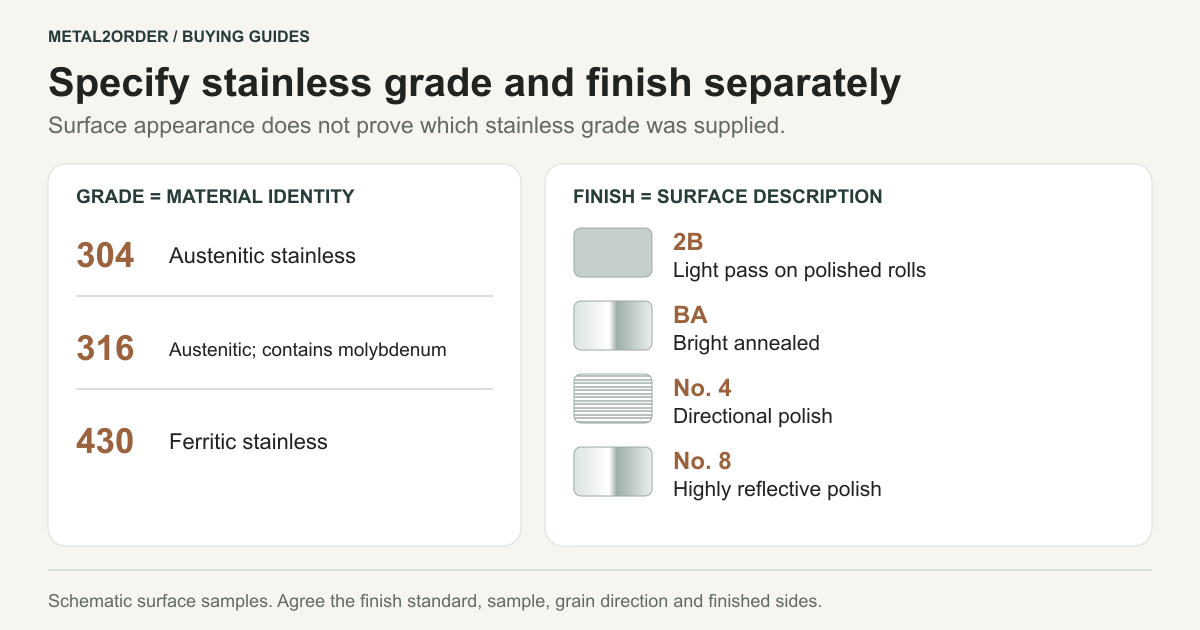
Treat 304, 316 and 430 as distinct grade labels
304 and 316 belong to the austenitic family; 430 is ferritic. The 316 family includes molybdenum in its composition. These distinctions do not, by themselves, establish that a sheet meets a design, food-contact, chemical-service or outdoor-exposure requirement.
Keep suffixes such as L when specified, and state the governing product standard. Grade names from different standards may have differing limits or conditions. Check the actual designation and certificate instead of relying on a supplier’s shorthand equivalence.
References: British Stainless Steel Association — 50 grades of stainless steel.
Describe the required surface separately
A market label such as “hairline,” “satin” or “mirror” can leave appearance unresolved. Agree a sample and the acceptance criteria rather than assuming every supplier’s finish will match. Do not infer surface roughness from gloss alone.
| Finish | General description | Details to agree |
|---|---|---|
| 2B | Cold rolled, annealed and descaled, followed by a light pass on polished rolls. | Applicable finish standard and surface acceptance requirements. |
| BA / bright annealed | A bright surface produced by annealing in a protective atmosphere after cold rolling. | Specified designation, reflectivity and a reference sample if appearance matters. |
| No. 4 / brushed | A mechanically polished surface with a directional appearance. | Grain direction, approved sample and any measurable roughness requirement. |
| No. 8 / mirror | A highly reflective polished surface. | Approved sample, visible surface defects and which side or sides are finished. |
References: worldstainless — surface treatment and finish descriptions.
Include finish direction, film and cutting requirements
- Material product standard, exact grade and required delivery condition.
- Thickness × width × length in mm, quantity and agreed dimensional tolerances.
- Finish designation; polished side or sides; grain direction relative to the part drawing.
- Surface acceptance sample or roughness requirement when specified by the design.
- Protective film type if required, edge condition, cutting allowance and identification after cutting.
- Material certificate requirements and the method of linking the supplied sheet or cut pieces to the documented batch.
Confirm identity and application requirements
A photo, a shiny surface or a simple magnet check is not a material certificate. Ask the supplier to identify the supplied grade and batch. Final selection depends on the environment, fabrication, cleaning and design requirements; this guide explains how to write the enquiry rather than approving an application.
References and scope
Sources checked for this guide on 28 September 2026. Standards pages and technical summaries provide context; use the agreed standard edition and purchase specification for the order. Examples are illustrative and do not confirm product availability.
- British Stainless Steel Association — 50 grades of stainless steel
Stainless families and grade distinctions. Match the purchase to its specified standard.
- worldstainless — surface treatment and finish descriptions
Mill, bright-annealed and mechanically polished surface finishes.