MS, CRCA, GI, TMT, ERW and D2 explained
Common market names are useful conversation starters, but they describe different attributes. MS is a broad steel description; CRCA and TMT describe processing; GI indicates galvanizing; ERW describes welding; D2 is a tool-steel grade designation.
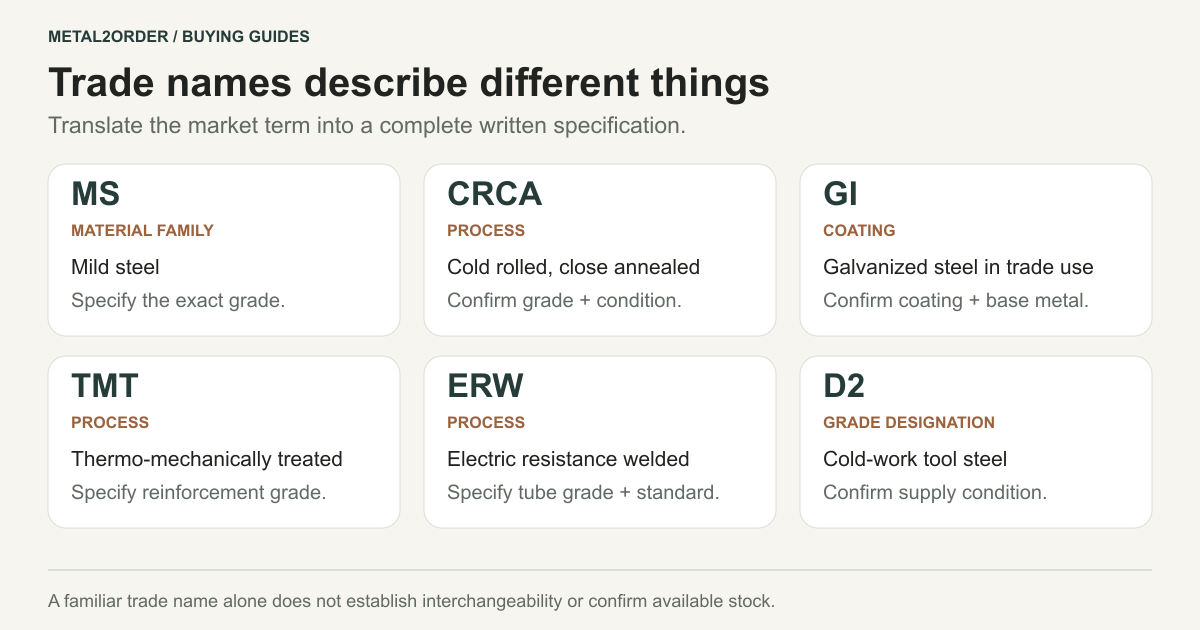
MS, CRCA and GI: ask for the missing specification
For galvanized sheet, IS 277 is a relevant product standard; it should not be applied automatically to every item sold as GI. A sheet, pipe and fabricated component need the appropriate specification for that product.
| Trade term | What it usually means | What to confirm |
|---|---|---|
| MS | Mild steel; a broad description used for low-carbon steel. | Product standard, grade, form and delivery condition. MS alone is not IS 2062 E250 or any other exact grade. |
| CRCA | Cold rolled close annealed steel. | Required grade and standard, thickness tolerance, surface quality and annealed / skin-passed condition. |
| GI | Galvanized iron in trade usage; commonly zinc-coated steel. | Base material, coating type and mass, thickness basis and the standard for the particular product. |
References: Ministry of Steel — iron and steel industry glossary, BIS — summary of IS 277:2018.
TMT and ERW identify a process, not the complete grade
TMT means thermo-mechanically treated. For reinforcement bars, order the specified grade under the applicable reinforcement standard, nominal diameter, length and quantity. IS 1786 covers high-strength deformed bars and wires for concrete reinforcement. Keep suffixes such as the D in Fe 500D when they are part of the specified grade.
ERW means electric resistance welded. It describes how a tube or pipe is made. It does not establish the steel grade, dimensions, heat treatment, testing or suitability for a particular service. Ask for the product standard and grade as well as the ERW requirement.
References: BIS — IS 1786 product-manual background, BIS — product manual for structural steel tubes, IS 1161.
D2 is not a generic word for every die steel
D2 is a cold-work tool-steel designation. A purchase still needs the governing material specification, product form, dimensions and supply condition. ASTM A681 addresses wrought alloy tool steels; the supplied material must be checked against the specified grade and requirements.
Do not silently replace D2 with a locally quoted “equivalent,” or assume an annealed bar already has the hardness of a heat-treated tool. State whether the order is for annealed raw material or a component with an agreed final heat treatment and hardness requirement.
References: ASTM — A681 alloy tool steels, ASTM — research on AISI D2 and cold-work tool steels.
Translate the shop term into a written enquiry
Keep the familiar market name alongside the complete specification if it helps communication. Where the correct grade is not yet established, mark it “to be specified” and resolve it with the designer or buyer before ordering. A similar name is not evidence of interchangeable material.
References and scope
Sources checked for this guide on 28 September 2026. Standards pages and technical summaries provide context; use the agreed standard edition and purchase specification for the order. Examples are illustrative and do not confirm product availability.
- Ministry of Steel — iron and steel industry glossary
Terminology for cold rolled, close annealed and galvanized steel products.
- BIS — summary of IS 277:2018
Scope and characteristics of galvanized steel sheet and strip.
- BIS — IS 1786 product-manual background
Background explanation of thermo-mechanical treatment. Consult the specified standard edition for ordering requirements.
- BIS — product manual for structural steel tubes, IS 1161
Identifies ERW separately from grade, dimensions and delivery condition.
- ASTM — A681 alloy tool steels
Scope of the wrought alloy tool-steel specification.
- ASTM — research on AISI D2 and cold-work tool steels
Primary technical reference identifying D2 as a cold-work tool steel.