How to specify a metal order
A useful metal enquiry identifies the exact material, its supply form, all controlling dimensions and the quantity. Add tolerances, condition and documentation before comparing prices so each supplier is quoting the same requirement.
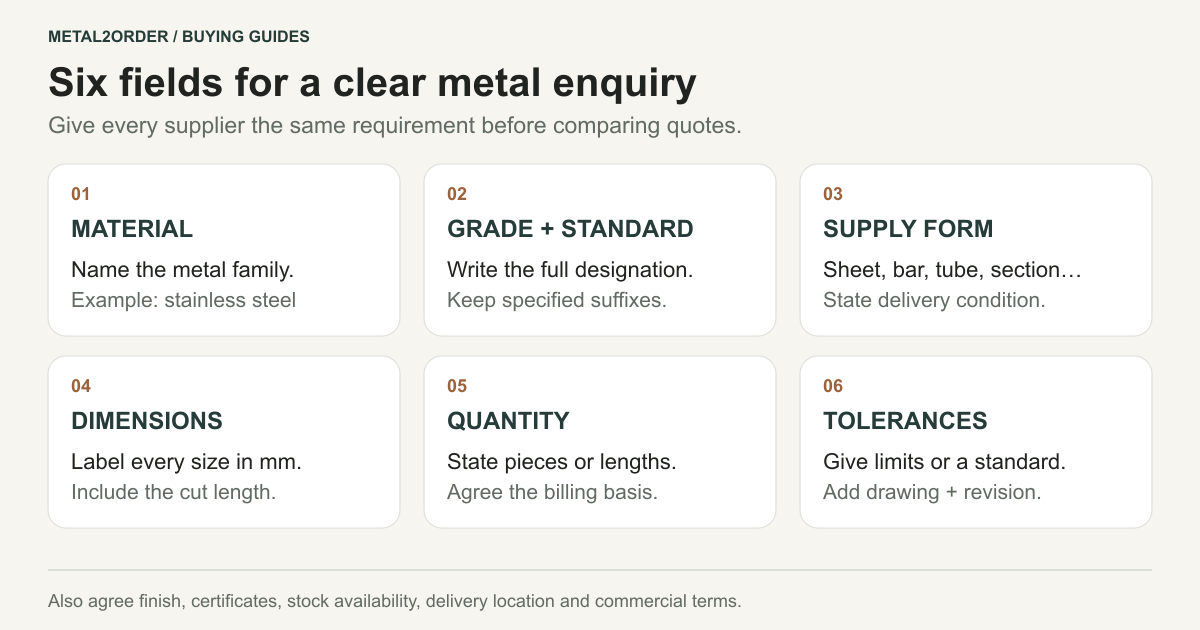
Name the grade and product standard
Start with the alloy or grade as written on your drawing or approved specification. “Steel,” “aluminium” and “stainless” identify broad families. They do not define the required chemical composition or delivery condition.
Include the product standard and edition where specified, plus temper or heat-treatment condition when relevant. A grade number, a product specification and a surface finish serve different purposes. Do not accept an “equivalent” grade without reviewing the supplier’s documented differences against your requirement.
References: ASTM — A480/A480M general requirements for stainless flat products.
Put labels and units beside every measurement
Write millimetres explicitly when using mm. A gauge number is ambiguous without its gauge system and material; request the thickness in millimetres as well. Keep quantities such as “10 pieces” separate from dimensions and total estimated kilograms.
| Supply form | Write these dimensions | Additional checks |
|---|---|---|
| Sheet / plate | Thickness × width × length | Thickness tolerance, flatness, edge condition and any protective film. |
| Round bar | Diameter × length | Diameter tolerance, straightness and machining allowance. |
| Flat bar | Thickness × width × length | Clarify rolled bar versus a strip cut from plate. |
| Pipe / round tube | Nominal size + schedule, or OD × wall; then length | Name the sizing standard; do not interchange nominal bore and OD. |
| Square / rectangular tube | Outside width × outside height × wall × length | Corner geometry and weld-seam requirements if they affect the part. |
| Angle / channel / beam | Full section designation + length | Use a standard section reference or a dimensioned profile drawing. |
Separate stock size from finished size
State whether dimensions describe the supplied blank or the finished component. If further machining is planned, the blank may need allowance on relevant surfaces. Put the allowance and cut tolerance on the drawing rather than expecting the supplier to infer them.
For each controlling dimension, specify a tolerance or refer to the agreed product standard. Include the drawing number and revision. A nominal dimension such as 10 mm is not a promise of exactly 10.000 mm.
Resolve the commercial basis before placing an order
- Ask whether the price is per piece, per metre, per theoretical kilogram or per measured kilogram.
- Have the supplier identify stock availability, minimum quantity, cutting or machining charges, packing, freight, taxes and delivery commitment in the quotation.
- Request the required material test certificate and traceability details with the enquiry; agree how the certificate will be linked to the supplied batch.
- Compare the offered specification against the request and record accepted deviations. A catalogue entry is a starting point for sourcing, not confirmation of supply.
References and scope
Sources checked for this guide on 28 September 2026. Standards pages and technical summaries provide context; use the agreed standard edition and purchase specification for the order. Examples are illustrative and do not confirm product availability.
- ASTM — A480/A480M general requirements for stainless flat products
An example of product-specific general requirements. It does not apply to every metal or supply form.
- ASME — B36.19 stainless steel pipe
Reference for the nominal pipe-size distinction in the dimension checklist.